
Paper2Agent: Nature turns manuscripts into MCP agents
Nature’s Paper2Agent converts papers and code into tested MCP servers that act like virtual corresponding authors.

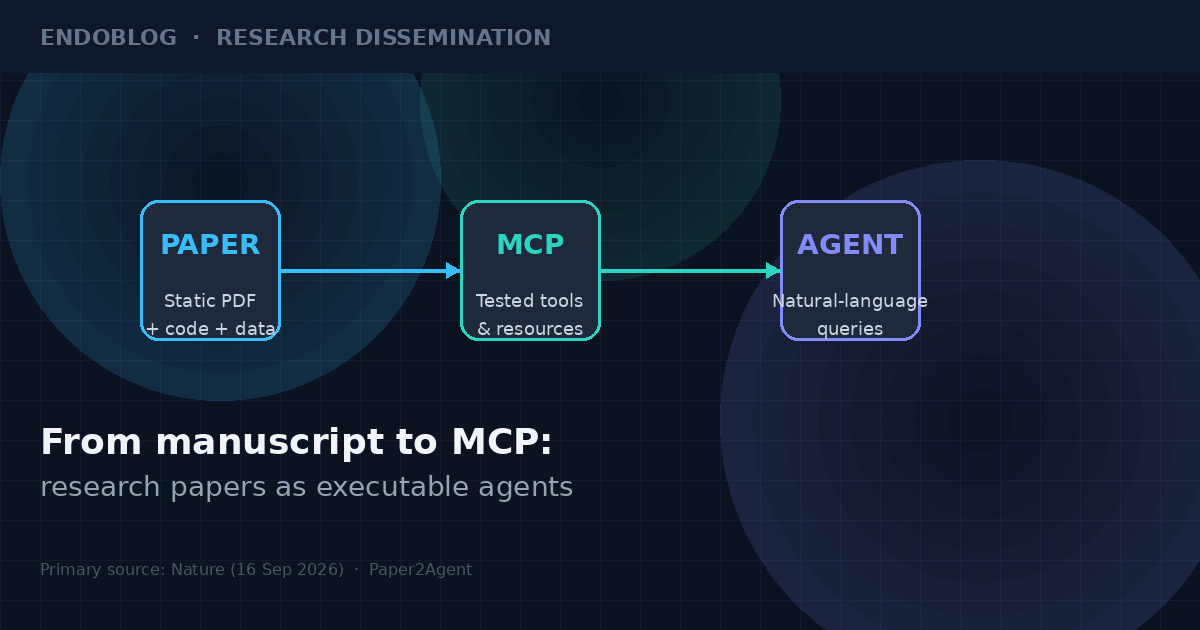
On 16 September 2026, Nature published Paper2Agent, a Stanford-led framework that converts a research paper’s text, code, and data into a Model Context Protocol (MCP) server, then wraps that server in a chat agent so other researchers can call the paper’s methods in natural language.
The useful claim is narrower than “agents can summarize PDFs.” Dissemination becomes executable: a paper is not only something you re-implement from prose, but a tested tool surface you can query.
What Paper2Agent builds
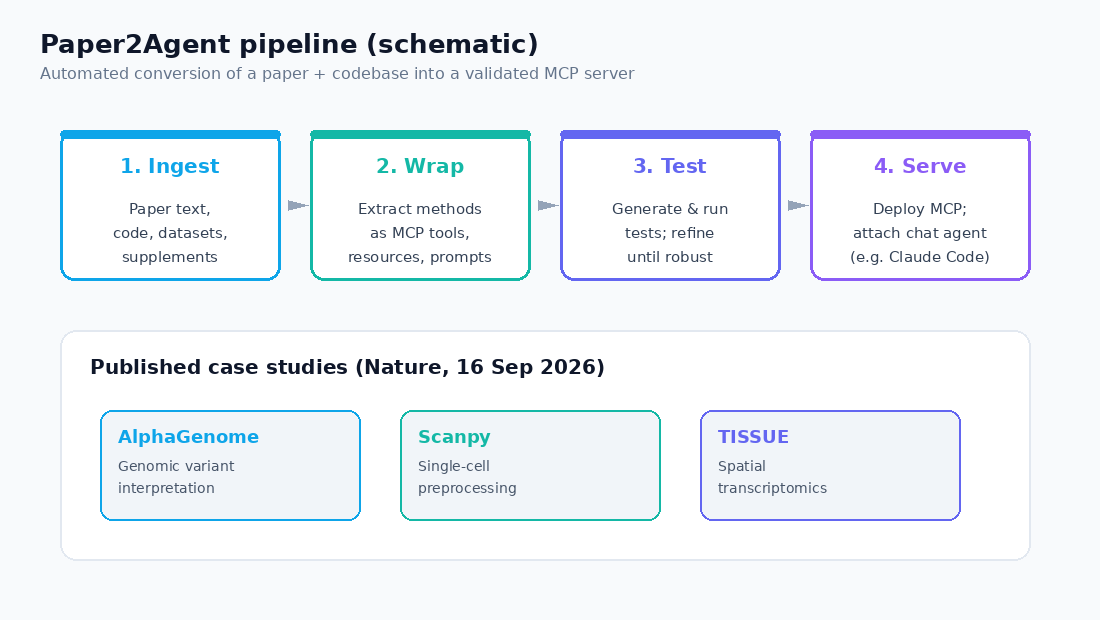
According to the Nature article and the authors’ arXiv preprint, the pipeline is automated and multi-agent:
- Ingest the manuscript, supplements, datasets, and codebase.
- 2. Build an MCP server that exposes tools, resources, and prompts drawn from the paper’s methods.
- 3. Generate and run tests against the MCP, iterating until the tool layer holds up better.
- 4. Connect the MCP to a chat agent (the paper discusses systems such as Claude Code) so users can run scientific queries in plain language while the agent invokes the paper’s workflows.
Nature’s news coverage (Glickman, 16 Sep 2026) calls the result a “virtual corresponding author”: an agent that can answer questions about the paper, apply its methods to new data, and work with agents built from other papers.
!Paper2Agent pipeline schematic: ingest, wrap, test, serve
Case studies
Most September 2026 coverage is frontier models and agent APIs. Paper2Agent sits one layer lower.
Scientific software has always encoded knowledge that papers only describe. The reuse tax is familiar: find the repo, install the environment, decode the API hierarchy, hope the tutorial still runs. Paper2Agent’s bet is that MCP becomes a standard interface for that knowledge, with automated testing as the gap between a demo wrapper and something other labs might trust.
Same-week adjacent work makes the pressure clearer. Agora (arXiv:2609.18094), submitted 16 September 2026, treats Git as shared memory for collective auto-research: claims as immutable commits, verification status as a first-class index. Different problem, same need: if agents join research, scientific knowledge needs machine-checkable, shareable state, not only prose.
Case studies
The research article runs Paper2Agent on three computational biology systems:
- AlphaGenome for genomic variant interpretation
-
- Scanpy for single-cell preprocessing and clustering
-
- TISSUE (transcript imputation with spatial single-cell uncertainty estimation) for spatial transcriptomics
The authors report that the resulting agents can reproduce results from the original papers and handle novel user queries. They also show multi-agent collaboration: Paper2Agent-built agents working together to prioritize a causal gene for psoriasis.
The companion news piece gives operational numbers for AlphaGenome: the agent was built in about 45 minutes for roughly US$14 of compute, and outperformed other biomedical agents (including Biomni) given the same paper and questions. Co-author James Zou (Stanford) says the approach can help “reimagine what knowledge looks like in the future.”
Implementation details and hosted MCP endpoints are in the Paper2Agent GitHub repository, including Hugging Face Spaces for AlphaGenome, Scanpy, and TISSUE.
Limits
Paper2Agent does not make every paper correct, complete, or ethically ready for autonomous reuse. It inherits the quality of the underlying code and data. Methods without clean repositories stay hard to agentify. Automated tests reduce fragility; they do not replace judgment about study design, consent, or clinical interpretation.
The psoriasis multi-agent example and the AlphaGenome re-analysis numbers are early signals. They are not a substitute for peer review or wet-lab validation.
What to watch
Three questions matter more than model brand names:
- Who hosts the MCP: authors, journals, labs, or third parties.
-
- How fidelity is measured beyond smoke tests: key-figure reproduction, adversarial codebases, and versioning when the paper’s software changes.
-
- What becomes citable: the PDF, the DOI, the MCP revision hash, or the trajectory that produced a new result.
For computational fields with executable methods, the paper is something you can call.