Long-Horizon Agents Need a Harness That Outlives the Context
Salesforce AI Research’s ten-day agent campaign argues continual operation without forgetting is a harness problem, before continual learning can even start.

Most agent demos still live inside one context window. Salesforce AI Research's 17 September 2026 paper starts from a blunter premise: enterprise work outlives the window, the process, and the human who opened the ticket. Their claim is that long-horizon agents must run continually without forgetting before they can learn continually, and that property lives in the harness around the model, not in the weights.
What they built
Nijkamp, Koul, Pakhomov, and Pang derive seven bottlenecks from that setting: autonomy, horizon, state, resilience, delegation, correctness, and cost. The architecture answers them with three pieces.
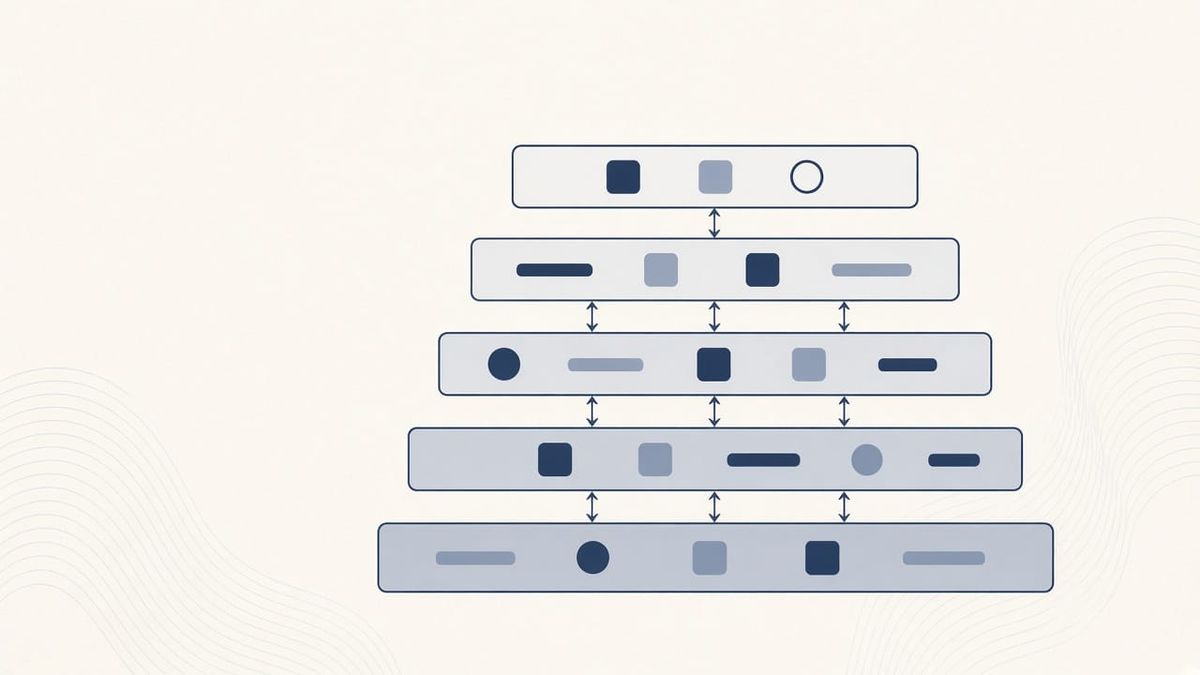
Levels indexed by time scale, each keeping a bounded file that summarizes the level below. Each clocked tick reads state, chooses an action, executes it, and writes the result back. Cascaded intelligence: run work at the cheapest tier that might succeed, review one tier up, escalate only after failure.
Persistent state is written to files rather than kept only in context. Compaction and session death are expected. Resume always starts from files.
The ten-day campaign
They put that harness on a hard reproduction task: a published result on asynchronous reinforcement learning for agentic training (Hou et al., 2026). A human attended about once a day. From the paper’s campaign table:
- About 10 calendar days, 8 under the clock
- 211 driver ticks, 47 context resets
- About 40 experiments
- 403 routine worker sessions and 35 strong-tier sessions
- 30 adversarial reviews, 7 of them critical findings
- 2,215 GPU-hours used against a 3,000 cap
- Labor spend roughly 86% routine and 14% strong
The agent reproduced the published result. Uncorrected policies collapsed past a staleness threshold at both scales; the corrected method held. Operating knowledge written early (standing decisions, reviewer kill rules, recipes handed down into briefs) changed later behavior with no weight updates.
The paper’s practical claim is that this accumulation can outperform weight updates as a baseline.
Where a learner would go
They are explicit that this is existence proof, not a benchmark: one campaign, one deployment. Their systems claim concerns where continual learning should run.
Continual learning for these agents, they argue, needs a substrate that outlives every context and process, and the checks the harness already runs are where a learner belongs. They argue that learning should occur inside persistent verification gates.
Longer contexts extend individual episodes, but they do not preserve a campaign across forty-seven resets.
Sources: Nijkamp et al., arXiv:2609.19519 (17 Sep 2026). Campaign numbers from Appendix Table 1 in that paper.